Pages

Wednesday, January 24, 2007

2nd National Catholic Bible Quiz held

The four families at the finals
of the 2nd National Bible Quiz.
Winner was Tabilin Family (4th from left)

The Tabilin Family of the Diocese of Malolos (Bulacan), besting three families, won the 2nd National Catholic Bible Quiz, held on Jan 22, 2007 at the Manila Peninsula Hotel in Makati City. The broad knowledge on the biblical text manifested by these four families, especially the Tabilin family, were amazing and impressive. Question such as "Where can find in the Bible the verse that says: "Today I am giving you a choice between good and evil, between life and death" (answer: Deut 30:15), was answered correctly and precisely in just a few seconds.

Mr. Leopoldo Tabilin, the father of the family is a jeepney driver while his wife Edna is vendor in a local public market. Among the three sons who were with them (Patrick, Percival, and Peter Paul), it was Patrick who had been winning earlier bible quizzes. The family was trained by a lay catechist and supported by the nuns of the Handmaids of the Divine Word Sisters from the Diocese of Malolos. Winning a bible quiz with a P50,000 prize is not only a family matter, the local church plays a significant role.

Among the alumni of the Divine Word Seminary who were present are Fr. Oscar Alunday, SVD, the executive secretary of Episcopal Commision on Biblical Apostolate; Bishop Arturo Bastes, SVD, head of the Commision; Bishop Elect Pol Jaucian, SVD, former provincial of the Philippine Central Province (he, this blogger and five others were asked to be part of the judges in the contest); and Bishop Joel Baylon of the Diocese of Masbate and head of the Episcopal Commissionon Youth (he did his theology in 1975-79, formation house was Tahanan ng Mabuting Pastol).

Miss Elvira Yap Go heads the Catholic Bible Quiz secretariat.
Members of of the Bible Quiz secretariat
includes Fr. Oscar Alunday, SVD (third from left)
and singer Miss Ivy Violan

Well, the biblical text was never really intended by the biblical writers to be quizzed on. We do have an instance in the Gospel of John, where, in a sort of true or false, the scribes and the Pharisees quizzed Jesus on the Hebrew Scripture: "The Law of Moses ordered adulterous women to be stoned to death" (see John 1-11). Many biblical experts, however, consider this text as a non-Johannnine interpolation.
The winning family and their supporters
with Cardinal Vidal and Bishop Bastes, SVD

Saturday, January 20, 2007

Second Sunday in Ordinary Time C: Santo Niño, Feast Proper to the Philippines

Fr. Paul Bumanglag, SVD missionary in Vicenza, Italy
poses in front of the monument of Antonio Pigafetta,
Magellan's chronicler. Vicenza was Pigafetta's hometown.


The Text: Isaiah 9:1-6 (NAB)
1 The people who walked in darkness have seen a great light; Upon those who dwelt in the land of gloom a light has shone.
2 You have brought them abundant joy and great rejoicing, As they rejoice before you as at the harvest, as men make merry when dividing spoils.
3 For the yoke that burdened them, the pole on their shoulder, And the rod of their taskmaster you have smashed, as on the day of Midian.
4 For every boot that tramped in battle, every cloak rolled in blood, will be burned as fuel for flames.
5 For a child is born to us, a son is given us; upon his shoulder dominion rests. They name him Wonder-Counselor, God-Hero, Father-Forever, Prince of Peace.
6 His dominion is vast and forever peaceful, From David's throne, and over his kingdom, which he confirms and sustains By judgment and justice, both now and forever. The zeal of the LORD of hosts will do this!
Commentary

Santo Niño
This Sunday, third Sunday in Ordinary Time, is feast of the Santo Niño (Holy Child), a feast proper to the Philippines. The origin of the first image of the Santo Niño (now in Cebu) is interesting. When Magellan came to the Philippine Islands in 1521, his chronicler, the Italian Antonio Pigafetta gave as a gift to the local queen, Doña Juana, an image of Santo Niño. When the Spaniards returned in 1565, they found an image of the Santo Niño inside a house, enthroned in a sort of an altar, the image adorned with flowers. Thus, it shows that the locals continued their veneration of the image even without the Spaniards for more than 40 years. A legend today would even claim that locals addressed the image as "Bathala" (the Filipino name of God). See other stories on the origin of the image of Santo Niño, click on this site.


The Liturgical Readings
The Old Testament reading (Isa 9:1-6) and the Gospel text (Lk 2:41-52) are probably chosen as Liturgical readings for this Filipino feast because they allude to the child as divine. The prophet Isaiah speaks of "a child is born to us…on whose shoulders dominion rests…and whose name is “Wonder-Counselor, God-Hero, Father-Forever, Prince of Peace" (9:6). The evangelist Luke tells us a story of a child who gets lost from his parents and eventually found in the Temple. Asked why such a comportment, the child replies that he must be in his "Father’s House' (2:49). The child would grow to become the divine Jesus of Christian faith.

Historical Background of Isaiah 9:1-6
The context of Isaiah 9:1-6 is not so clear though biblical scholars share some reasonable suggestions. The text is likened to ancient Egyptian rituals celebrating the accession of a new pharaoh. Such enthronement is usually accompanied by the giving of throne names by the assembly of the gods and goddesses which ends with the divine assembly adopting the king as their child. Notice that in Isaiah 9, four names are conferred on the child.

A few suggestions have also been made as to the identity of this anonymous child “who is born to us” and who becomes a ruler. The most reasonable that we can think of here is the birth of Hezekiah, the future king of Judah. Both biblical and extra biblical sources attest to the war strategy employed Hezekiah against the invading Assyrian army led by Sennacherib (705 BC – 681 BC). In that invasion, through Hezekiah’s negotiation and prayer, Jerusalem was spared (2 Kings 18-20, Isaiah 36-39, click also this).
The Downfall of Sennacherib, an early work of Rubens (photo grab Wikipedia)

The text speaks of oppression in the familiar images of servitude yoke, pole, and rod (v. 3) - a "yoke placed in the neck" (Isa 10:27); the pole is used to strike the shoulders (see Isa 10:24); and the rod is an instrument for beating prisoners into subjection (see Isa 10:24).
The identity of the oppressor in this text is not also specified but interpreters point to a brief period foreign rule by the Assyrian empire, perhaps during campaign of the Assyrian king Tiglath-Pileser III (744-727 B.C., see 2 Kgs 15:29) and later on continued by Shalmeneser V (726-722 B.C.). Oppressive means in those times include the payment of tributes to the empire and the exile of its leaders.
In any case, prophet Isaiah portrays in symbolic imagery the coming liberation of its people from oppression: the transition from the land of gloom (9:1), figurative language for the underworld (see Job 10:21-22) to a place of brilliant light. In other words, there will be an end to hostilities, war is abolished and replaced by "abundant joy". There will be peace (shalom) characterized by "judgment and justice" (mishpat and tsedaka, see 9:6).
All these great events would surely unfold because of the birth of a wonderful child.
The fact that such great hope could rest on a child would be a factor for Christians to identify the child with Jesus (note that this text is read at Christmas midnight mass, see also Lk 1:33).

The Child as Divine
It is unusual in the Bible and even in ancient Near East that a deity assumes the form of a child. In contrast, when gods are described, images that characterize strength and power are used. In Canaanite religion, the supreme god, called El, bears the title of "Bull". The goddess Anat could take form of an eagle. The god Baal is associated with thunder. In the Bible, God is at times compared with a lion (see Amos 1:3) or an eagle (Exod 19:4), even with a mother (Isa 66:13), but rarely with a child. The reason, perhaps, is that a child symbolizes weakness.

In short, that our God would assume the form of a child speaks of his humility and solidarity with those who are weak. St. Paul in his letter to the Philippians articulates best this divine humility and solidarity (called kenosis in Greek):

Christ Jesus, who, though he was in the form of God, did not regard equality with God something to be grasped.
Rather, he emptied himself, taking the form of a slave, coming in human likeness; and found human in appearance,

he humbled himself, becoming obedient to death, even death on a cross. (2:6-8 NAB).

Tuesday, January 16, 2007

Edwin Fernandez and Teofilo Perey, SVD missionaries here for a visit

Fr. Edwin Fernandez (left) missionary in Chile
and Fr. Popo Perey (right) missionary in Chad

Two former SVD scholastics, graduates of the Divine Word Seminary, dropped by their former home for a visit. Fr. Edwin Fernandez, SVD, 37, born in Binmaley, Pangasinan ordained in 1996 is the present recor of the SVD seminary in Chile. He has been a missionary in Chile for ten years now, going there immediately after ordination. Please click on this for SVD Chile website.

Fr. Teofilo "Popo" Perey, SVD, 51, is from Indang, here in Cavite. Before he entered Christ the King Seminary in 1985, he was an engineer working with Local Water Utilities Administration (LWUA) in Quezon City. After ordination, he was sent to Togo, a country in West Africa, and a former German colony. Three years ago, the SVD superior general asked Popo to be one of the pioneeer SVD missionaries to Chad in Central Africa.
Fr. Tony Pernia, SVD superior general
celebrating a Mass on his visit to Chad

A day in the life of a missionary:
Fr. Popo Perey (wearing a hat) helped "liberate"
their mission car stuck in the mud.

Chad has 7.5 million people with 20% Christians (7% Catholics), 60% Muslims and the rest Ethnoreligionist. 80% of the population lives below poverty line due to a hostile climate, long years of civil war, corruption, and a high rate of illiteracy. Chad is easily one of the poorest countries in teh world. This is the kind of place that the SVD would want to go to "preach the Good News."
Chad missionaries themselves have to till the soil to survive


Chad's Basic Ecclesial Community meeting under the tree

Chad photos credit: Fr. T. Perey, SVD

Friday, January 12, 2007

Points for Homily: Second Sunday in Ordinary Time C -- A New Name, A Crown, and A Wedding (Isaiah 62:1-5)

A wedding in Aguinaldo, Ifugao
Here are some points for Homily and Spiritual Reading on this coming Sunday's Readings (14 January 2007). This commentary will focus on Isaiah 62:1-5 (first reading) entitled in some commentaries as "Apostrophe to Jerusalem".

Text: Isaiah 62:1-5 (from NAB)
1For Zion's sake I will not be silent,
for Jerusalem's sake I will not be quiet,
Until her vindication shines forth like the dawn
and her victory like a burning torch.
2 Nations shall behold your vindication,
and all kings your glory;
You shall be called by a new name
pronounced by the mouth of the LORD.
3 You shall be a glorious crown in the hand of the LORD,
4 No more shall men call you "Forsaken,"
or your land "Desolate,"
But you shall be called "My Delight,"
and your land "Espoused."
For the LORD delights in you, and makes your land his spouse.
5As a young man marries a virgin,
your Builder shall marry you;
And as a bridegroom rejoices in his bride
so shall your God rejoice in you.

Points:
1. The ministry of the prophet. Note that the speaker here is a prophet whose ministry is one of being "not silent" and "not quiet". Reading further this ministry is compared to sentinels ("watchmen" or "security guards") stationed on the walls whose task is to remind Yahweh continually of his promise to liberate Jerusalem. This prophetic ministry is one of intercession and prayer in behalf of the community.
2. The background. The prophet is anonymous but preaches in the tradition of Isaiah. This section of the book, from chapters 55-66, is often called by biblical scholars as Third Isaiah written after two hundred years from the time of Isaiah. The context of our reading is the end of the Babylonian Exile (around 537 B.C.).

It was becoming certain that the exiled people of God would be allowed to return to their homeland in Judah and once again be free to worship Yahweh in Jerusalem and to begin a new life. This exciting change to a better life is symbolized in the change of the status of Jerusalem. This change is expressed in three symbols -- (1) a new name, (2) a crown, and (3) marriage.

3. A new name. From the name "Forsaken" (Hebrew "Azubah" = Abandonada) and "Desolate" (Hebrew "Shemamah"), Jerusalem is renamed "She's my Delight" (Kepsi-bah = Tagalog "O Giliw ko") and "Married" (Hebrew Beulah, Tagalog "Pinakasalan") In the Bible, change of names indicates a new status. We have another example in the book of the prophet Hosea where the prophet is told to rename his children from Lo-ruhamma-"No Mercy" to Ruhamma -"Mercy" and Lo-ammi – "Not My People" to Ammi - "My People" (Hosea 1:6,9 and 2:25). We recall also Ruth's mother-in-law who invited the people of Bethlehem to call her Mara ("Bitter") rather than Naomi ("Pleasant") because of the suffering that she experienced - she was widowed (see Ruth 1:20). Likewise, the change of name from Saul to Paul might have something to do with Paul’s conversion on the way to Damascus (Acts 13:9).

Naomi entreating Ruth and Orpah
to return to the land of Moab by William Blake, 1795
photo grab wikipedia

4. A crown. In this text, there seems to be a coronation. The Lord is presented as placing a crown and a diadem on Jerusalem (v. 3). In antiquity, like in Babylon, when a city is said to have been crowned by a deity, that city is to be protected by the gods. In the same way, the crowning of Jerusalem is not only to raise her status from being a slave city to a free and honorable one but also because the Lord assures Jerusalem to be under his care.

5. The marriage. Here the prophet uses the metaphor of marriage to express the new status of Jerusalem. If Jerusalem felt abandoned during the exile, now she is being loved, in fact being courted by no other than the Lord. Here the Lord is the groom marrying his bride, Jerusalem. Such relationship between God and his people expresses more intimacy than the usual covenant relationship which is more political and diplomatic. Again we are reminded here of the love story of Hosea imitating the love story between God and Israel. As unfaithfulness led to the break-up of the marriage between Hosea and Gomer, so is Israel's infidelity. But the Lord is always a faithful lover that he seeks out Israel in spite of her infidelity (see also Isa 62:12). The use of the symbolism of marriage to express God's love to his people is probably the reason why, in our liturgy, the Gospel reading is about the Wedding at Cana (John 2:1-12).

6. Certainty of God’s promise. In any case, each of these symbolisms indicates the certainty of the prophetic word and the fulfillment of God’s promise to act in behalf of his people. This is also our assurance and our hope as we live in this "valley of tears". As St. Paul says in one of his letters, "We know that all things work together for good for those who love God" (Rom 8:28).

From a reflection of John Donahue, SJ.

In the early church the Epiphany cycle included other manifestations of Jesus—his baptism and the wedding at Cana. Today’s liturgy focuses on the third manifestation, the wedding feast at Cana, the first of Jesus’ signs, that is, symbols of the divine power at work in the incarnate Word. The Gospels this Sunday and next provide distinct pictures of the inauguration of Jesus’ public ministry. Please click on this for the full article.

From a reflection of Raniero Cantalamessa, OFM

The Gospel of the second Sunday in Ordinary Time is the episode of the wedding feast at Cana. What did Jesus want to tell us by participating in a wedding feast?

Above all, in this way he in fact honored the marriage between man and woman, implicitly reaffirming that it is a beautiful thing, willed by the Creator and blessed by him. But he wanted also to teach us something else. With his coming the marriage between God and humanity promised through the prophets was realized under the name of the "new and eternal covenant."
Please click on this for the full article.

Thursday, January 11, 2007

Bishop-elect Leopoldo C. Jaucian: Curriculum Vitae

Bishop-elect Pol Jaucian, SVD concelebrating
with Bishop Chito Tagle at the fiesta of
Poong Hesus Nazareno Church
Dasmarinas Bagong Bayan, Cavite
Announcements:

The ordination of Bishop-elect Pol Jaucian, SVD is set on 26 March 2007, this years solemnity of the Annunciation, at the Divine Word Shrine in Christ the King Mission Seminary along E. Rodriguez Blvd, Quezon City. His Eminence Gaudiencio Cardinal Rosales is the ordaining bishop.

The installation of the bishop-elect will be on 31 March 2007 at the Cathedral of St. James in Bangued, Abra. He will be installed by Archbishop Ernesto Salgado of Nueva Segovia (Vigan, Ilocos Sur).


Here's more biographical data of the incoming bishop of the Diocese of Bangued in Abra (source: Provincialate of the SVD Central Province):

Name : LEOPOLDO CORPUZ JAUCIAN
Date of Birth : July 27, 1960
Place of Birth : Santa, Ilocos Sur
Civil Status : Single
Citizenship : Filipino
Religion : Catholic
Parents name : Ernesto Ballesteros Jaucian, Sr.
Veronica Bello Corpuz
Home Address : Catholic Trade Bldg. 1916 Oroquieta,
Sta. Cruz, Manila

Education:

Lalapac Elementary School : Elementary Education 1966-1972
Divine Word Academy, Urdaneta, Pangasinan: Secondary Education 1972-1976

Christ the King Seminary,Q.C : A.B Philosophy, Postulancy 1977-1979
Divine Word Seminary, Tagaytay : Novitiate 1979-1981
Taiwan
, R.O.C : Overseas Training Program 1982-1984
Fu Jen Catholic University Taipei, Taiwan, R.O.C : Theology 1984 - 1987
De la Salle University, Manila: MA units in Guidance Counseling 1992-1995

Work Experience
Christ the King Mission Seminary : Sacristan 1976-1977

Religious Vows and Ordination
Chiayi, Taiwan,R.O.C : Perpetual Vows September 8, 1987
Fu Jen Catholic University : Ordination to Diaconate September 27, 1987
Divine Word Academy Chapel, Urdaneta, Pangasinan : Ordination to Priesthood
Ordaining Prelate : Bp. Miguel Cinches, SVD,D.D March 12, 1988

Assignments
St. Joseph the Worker Parish Chiayi, Taiwan, R.O.C : Assistant Pastor June 1988 - 1989
Fu Jen Catholic High School Chiayi, Taiwan, R.O.C : Campus Minister August 1989 - 1992
St. Jude Catholic School near Malacanang : Campus Minister, Assistant Principal and Assistant Director July 1995-July 2000

From August 2000 to March 2005
St. Jude Archdiocesan Shrine near Malacanang: Parish Priest;
Discrict superior of the SVD Manila District;
Vicar Forane of the Archdiocese of Manila - Vicariate of San Jose de Trozo

From March , 2005 to January 2007: Provincial Superior of the SVD Philippine Central Province

Wednesday, January 10, 2007

Feast of Poong Hesus Nazareno celebrated

Children danced the Gloria in
the Holy Mass for the fiesta of Hesus Nazareno Church;
main celebrant: Bishop Chito Tagle

The Church of Poong Hesus Nazareno, an SVD administered parish in Dasmarinas Bagong Bayan in Cavite, celebrated its fiesta last 09 January with Bishop Chito Tagle as the main presider in the Eucharistic Celebration. Most parishoners are relocatees, meaning former "squatters" of Manila who were resettled to this place in the mid-80's.
Concelebrants in the photo are
Fr. Joey Guinto (assistant parish priest);
Fr. Arnel (diocese of Imus);
Fr. Alex Muana, SVD (missiology professor at the DWS);
Fr. Marty (diocese of Imus);
also in the picture is Mrs. Teresita R. Jaca, lector and one of
the pioneer members of the church


The parish is significant to Divine Word Seminary as two of its professors, Fr. Jerome Marquez (Canon Law) and Fr. Randolf Flores (Biblical Studies), had helped begun in the summer of 2001 the establishment of the church and basic ecclesial communities. Seminarians from DWST also come to the parish for their week-end apostolate.

Click on the image for a videoclip of Bishop Tagle's homily on Hesus Nazareno.


You can download the full homily here, click on this Poong Hesus Nazareno
note: at megaupload wait for 45seconds, at the last 10 seconds an ad pops out and blocks the download box, close that ad and click download. This is an MPEG file 431MB, it will take some time to download, be patient.

Sunday, January 07, 2007

Ordination date of bishop-elect Leopoldo C. Jaucian set

Fr. Pol Jaucian during the Triduum Mass
for the Hesus Nazareno Fiesta
Poong Nazareno Church, DBB Dasmarinas, Cavite


Leopoldo "Pol" Jaucian, SVD, bishop-elect of the Diocese of Bangued in Abra will be ordained as bishop on 26 March 2007 at the Shrine of the Divine Word in Christ the King Seminary along E. Rodriguez Blvd, Quezon City.

Friday, January 05, 2007

Leopoldo Jaucian new bishop of Bangued, Abra


Bishop-elect Pol Jaucian (middle) was the main celebrant
in the Mass of the Epiphany at the SVD administered
Poong Nazareno Church in Dasmarinas, Cavite,
also a Triduum mass for the Church's fiesta on 09 Jan 07.
Concelebrants were Joey Guinto (right, assistant parish priest)
and Ed Orpilla (left, parish priest)


The Holy Father has appointed Fr. Leopoldo "Pol" C. Jaucian, SVD, the current provincial of the SVD Central Province as bishop of the Diocese of Bangued in Abra. The appointment was posted at the Vatican Information Service and broadcast over Radio DZPA in Bangued at 7:00 this evening (05 Jan 2007)

Indeed, this is a good news for Abra as the province needs urgently a shepherd in the midst of worsening political situation and violence. Before Christmas, the congressman of Abra, Luis Bersamin, was murdered in the compound of a church, after attending a mass.

The Diocese has a population of 236,545 with 198,497 Catholics. There are 38 priests and 38 religious. Abra was the first mission area of SVD missionaries when they first came to the Philippines in August 1909.

Fr. Jaucian was born in Santa, Ilocos Sur on July 27, 1960. He grew up in Urdaneta, Pangasinan and finished his high school at the Divine Word College ofUrdaneta. He entered Christ the King Seminary not as a seminarian but as one of the sacristans being a working student. He later joined the postulancy program and in 1979 entered the Novitiate in Divine Word Seminary, Tagaytay City. He spent a number of years in Taiwan for the Overseas Training Program for SVD scholastics and also did his theological studies there. He pronounced his perpetual vows in 1987 and was ordained to the priesthood in 1988.

After ordination, Pol worked as a missionary in the China province of the SVD (Taiwan and Hongkong). After sometime, he was appointed parish priest of St. Jude Shrine near Malacanang and in 2005 he was elected provincial of the Philippine Central Province.
Bishop-elect Fr. Pol Jaucian(first one standing from right, in white Polo Barong)
with the Filipino delegates of the SVD Chapter in Rome last July 2006
Standing from left: Jerome Marquez (St. Jude Catholic School director),
Pablito Tagura (rector of Christ the King Seminary),
Ronnie Crisostomo
(student, Liturgical Studies),
Jerome Adriatico
(provincial of the Northern Province),
John Benas (missionary in Mexico),
Bubi Scholz
(now the SVD Archivist),
Dionisio Miranda
(Moral Theology professor),
Jing-Jong Rocha (Vice-Provincial of the Southern Province),
and bishop-elect Pol Jaucian;
seated from left: Oliver Quilab (doctoral student in Germany),
and Joey Artienda (missionary in Ecuador).

Sunday, December 24, 2006

A Christmas Reflection

Mother and Son with Aunt
Badjaos begging infront of the Church
in Balayan, Batangas

The following is a Christmas reflection written in December 2001 by the late Fr. Anthony R. Ceresko, OSFS for a handout of Simbang Gabi homilies.

"Today"
So they went in haste and found Mary and Joseph, and the infant lying in the
manger. When they saw this, they made known the message that had been told them about this child. All who heard it were amazed by what had been told them by the shepherds (Luke 2:16-18).
Some years back I had the opportunity to attend an audience with Pope John Paul II. I was not able to come near to the Pope because of the crowd. But I remember how the Pope entered the place of the audience on foot, walking down the aisle taking the hands to the pilgrims and blessing each one, especially the children.

But the Pope's favorites were the small children and infants. When he saw an infant being held out to him by the mother, the Pope loved to take the child into his own arms and embrace the child affectionately as he gave it his blessing.

There is something in all of us that is drawn to the simplicity and vulnerability of infants. We instinctively feel an attraction and desire to protect. Thus the centerpiece of our Christmas season is the infant Jesus lying in the borrowed bed in a borrowed shelter, watched over the protected by his young and perhaps bewildered and anxious parents.

In the midst of our Christmas celebrations, perhaps it is good to fix our attention on that vulnerable babe lying in the dark and damp stable lighted only by one or two lanterns and reflect on the children of our world today.

It may be good to remind ourselves that so many, too many, children who are born this very day face similar precarious and anxious circumstances as this child born more than two thousand years ago in Bethlehem.

Traditional Belen (Nativity Creche) inside Hesus Nazareno Church
an SVD parish in Dasmarinas, Bagong Bayan, Cavite

A speaker at an international conference on the plight of millions of underprivileged children made a moving call. She said,

We are guilty of many errors and many faults but our worst crime is abandoning the children, neglecting the fountain of life. Many of the things that we need can wait. The child cannot wait. Right now is the time his bones are being formed, his blood is being made, and his senses are being developed. To the young child we cannot answer, "Tomorrow". His name is "Today" (repeat): His name is "Today".
The children born into poverty, the children born into anxious and trying circumstances call out to us in the person of that child of poverty born at Bethlehem. "Today" is the name of the poor, and we are called upon to respond to them as a community of the disciples of Jesus, who preached about the coming of God’s kingdom to the "poor". How do we respond to their cries? How do we hold out some hope to them?

I would suggest that, one way would be in examining the priorities in our decision making during the coming year – our decisions as individuals, our priorities as a society, our decisions and priorities as a people. Our former President is on trial at this moment, charged with violating the public trust. What are the criteria by which we make decisions regarding the guilt or innocence of an individual? What are our criteria and priorities in choosing public officials and leaders?

As a nation we face difficulties in the future in the economic sphere, and the challenges and pressures with regard to globalization. How do we establish criteria and decide on the priorities for our economic arrangements?

For ourselves as individuals or as families, what are our criteria and priorities in our decision-making? Certainly the example of the patience, the simplicity, the mutual love of the manger scene at Bethlehem offers us one example: no throne or sumptuous palace for this new born messiah-king. But for so many millions of children born into our world today, a single night’s shelter is not enough. The child of today, needs food and clothing and shelter, clean and safe water, health care, education: "TODAY" is the name of the poor. When we talk about priorities and criteria for decision-making, we can see here the logic and wisdom of the Church’s “option for the poor” – the poor, especially the children, cannot wait until tomorrow.

This is the criterion that the Church offers for our decision-making, our priorities our policies – in the government, in society for our national leaders, for our economy, and in our personal lives. This is the criterion that Jesus proposed: I was hungry, and you gave me something to eat. I was thirsty, and you gave me something to drink; naked and you clothed me, a stranger and you took me in, like the innkeeper in Bethlehem who offered that poor family shelter from the cold night almost two thousand years ago this very day.

When we gaze with wonder on this manger scene and the young couple with their newborn child, poor and helpless, we also see ourselves, our own poverty, our won helplessness in the face of so many challenges that confront us as individuals and families, as a society and as a people. But the message that this poor child brings is that we are not alone. God has not abandoned us despite our blindness, our selfishness, and our failures. Emmanuel, "God is with us," is the name that the angel proposed when his birth was first foretold.

Today’s reading from the letter to Titus sums it up beautifully:
But when the kindness and generous love of God our savior appeared, not because
of any righteous deeds we had done but because of his mercy, he saved us through
the bath of rebirth and renewal by the holy Spirit, whom he richly poured out on
us through Jesus Christ our savior, so that we might be justified by his grace
and become heirs in hope of eternal life (3:4-7).

Simbang Gabi in Balayan

A simbang gabi mass with
the community of Barangay Baclaran,
Balayan, Batangas
During Christmas season, parish priests in and outside Tagaytay request help from the seminary professors to celebrate the Simbang Gabi masses (traditional nine day novena masses before Christmas). For more than ten years now, some SVD priests go down to Balayan in Batangas, 60 kilometers east of Tagaytay, a first class municipality (population ca. 70,000) with 48 barangays. Each priest is assigned to celebrate at least four masses a day usually in the barangay chapels, sometimes in basketball courts.
Chapel of Barangay Baclaran,
Balayan, Batangas
For this year's Simbang Gabi, SVDs who are helping out there are Martin Mandin (Moral Theology professor), Mike Layugan (Dean of Studies), Ariel Tampos (preparing to go to Botswana in Africa) and this blogger.
The Church of Immaculate Conception
Balayan, Batangas, Philippines

Saturday, December 16, 2006

Simbang Gabi

After a Misa de Gallo in Hinalong
a chapel on the mountain of Aguinaldo, Ifugao
December 2004

Today is the first day of Misa de Gallo ("Mass of the Rooster") known as "Simbang Gabi" ("Dawn Mass"). Many churches though have already begun Simbang Gabi last night. For those preparing homilies and who would want to reflect further on the liturgical readings, here are some sites:

Simbang Gabi

1) http://www.angelfire.com/journal2/r_flores/

-Tagalog Simbang Gabi homilies written by students of Divine Word School of Theology (Tagaytay City) in December 2004 and uploaded in this site by RCF.

2) http://www.recoletos.ph/

-the official website of Recoletos Philippines where in the section “Homilies” you can read the Simbang Gabi sermons in English by OARs delivered last year (2005). It also includes other homilies for certain occasions.

3) http://www.geocities.com/josephdream/index.htm

-personal website of Fr. Lito Jopson, diocesan priest of the Diocese of Pasig; contains an archive of his Sunday and Simbang Gabi homilies (English).

Sunday Readings

4) http://liturgy.slu.edu/

-website maintained by Center for Liturgy at St. Louis University (Missouri) where the Sunday Readings are explained by six authors using different approaches arranged in a kind of hexapla (“sixfold”). One of writers, Dr. John Pilch, once visited the Philippines as the guest speaker of CBAP.

5) http://www.cantalamessa.org/en/index.php

-personal website of Fr. Raniero Cantalamessa, a Franciscan Capuchin and Preacher to the Papal Household. The site contains his homilies and talks. A Sunday homily is usually uploaded on Saturday afternoon (Manila Time)


THIS BLOG WILL COME OUT WITH A VERY IMPORTANT NEWS IN A FEW DAYS (besides the upcoming Prayer Rally organized by the CBCP). "Watch and Pray"!

Wednesday, December 13, 2006

Arnoldus Company in concert


A
rnoldus Company, a singing group composed of SVD scholastics, had just staged their first live concert up in the heart of Northern Luzon, in Laoag City, 10 December 2006. Hosted by Divine Word College of Laoag , the concert was successful and highly appreciated by the audience composed mostly of students and staff of the DWCL.

Fr. Raul Caga, SVD, the singing SVD priest, is the director of the group and responsible for reviving Arnoldus Company which was founded in the late 70's. Former SVD novice Nez Marcelo is the present musical director and composer.

Thursday, December 07, 2006

Ming Ramos and the Seminary Garden

First Lady Ming Ramos

One the day before the feast of Immaculate Conception, the seminary opened its garden to the public. Former First Lady Ming Ramos who owns the famous Ming's Garden near Tagaytay cut the ribbon while Fr. Fred Saniel, SVD rector prayed the blessing witnessed by the scholastics and staff and some friends of the seminary.
Seminary staff Cha, Cory and Demy pose
beside the Buddha Bamboo
in the Garden of Providence

The garden, the work of Fr. Mike Layugan, SVD Dean of Studies, is located adjacent to the Dining Hall of the Fathers and the Brothers and named "Garden of Providence" because, as the rector said, "the garden came to be through the generosity of benefactors."

Watch a videoclip of the blessing of the Garden of Providence. Click on the image below.


The two "bahay kubo" (nipa hut) were donated by OFWs in Rome, care of Miss Divine Santos and family. The plants which are all for sale came from the gardens of Mrs. Meyer and Mrs. Ramos.
Lady in red is Mrs. Meyer who was celebrating
her birthday on the same day.

The proceeds of the sale of the plants will go for the maintenance of the seminary.

Some of the plants in the Garden of Providence:
Pelican plant (Aristolochia gigantea)
from the garden of Mrs. Meyer;
its unopened bud resembles a sleeping pelican,
high climbing with leaves up to 10 in
(origin: Costa Rica)

Bishop Tagle on Telling the Story of Jesus in Asia

Bishop Tagle talks on "Telling the Story of Jesus in Asia"

Bishop Chito Tagle of the Diocese of Imus, who teaches Theology of the Priesthood and Synthesis of Dogma, spoke last Tuesday (Dec 5) to the academic community and to the religious of Tagaytay. The talk was on the paper he delivered at the Asian Mission Congress last October 18-22 in Chiang Mai, Thailand.

The theme of the Congress speaks of how Christians do mission today in this great continent, "Telling the Story of Jesus in Asia". Click on this to read the official statement of the Congress.
Participants gather for the Eucharist
at the closing ceremony
of the Asian Mission Congress in Thailand
(photo credit: fabc.org)

Bishop Tagle underlined in his talk the power of a story to communicate a message. As life is in quest of a narrative, narrative transforms life. A story poses a better world in which one can inhabit.
Members of Tagaytay Religious Community stands
to pray at the end of Bishop Tagle's Talk

One day, a certain Korean nurse, the bishop narrates, gets curious of fellow nurses who gather every lunch break and are always happy. She asks what they are doing and fellow nurses tell her about their gathering together to celebrate the Eucharist, narrate to her about the story of Jesus. The Korean lady buys her own bible to read about Jesus and later on joins the group, becomes a Christian and ends up studying theology in the Philippines. Now she is a theological adviser to her Bishop in Korea.

Click on the image below to watch the initial part of Bishop Tagle's talk. Write to rrandy33@yahoo.com if you want a complete copy of his talk in DVD format.

Wednesday, November 29, 2006

Christ the King

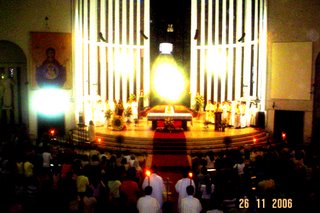
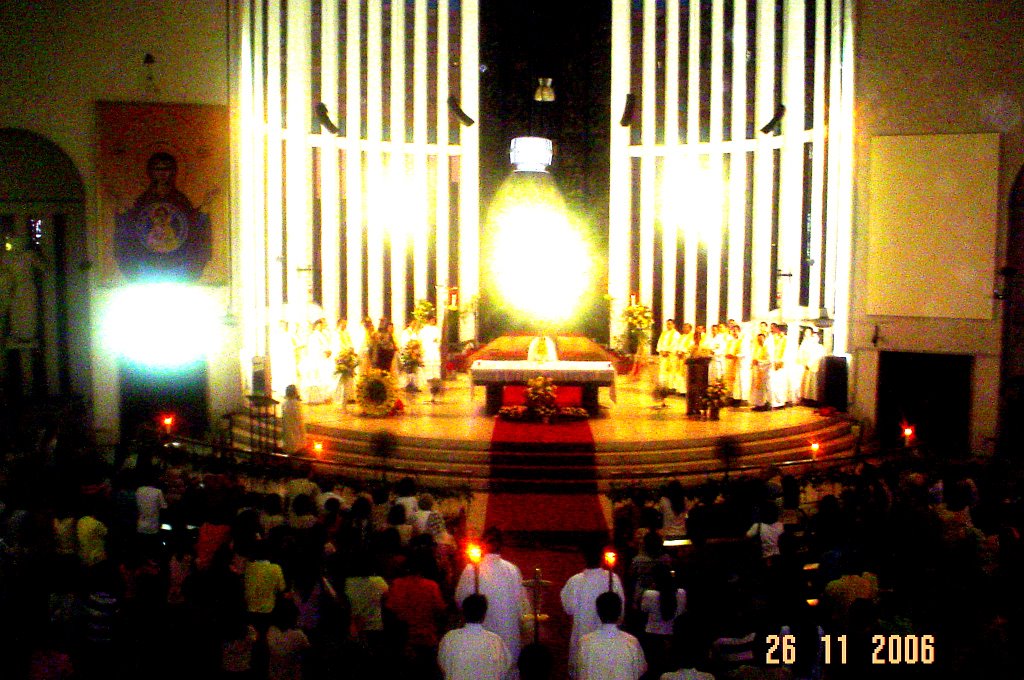
Holy Mass in honor of Christ the King
at the Shrine of the Divine Word
Quezon City

The following is this blogger's homily during the Christ the King Feast Celebration last November 26, 2006 at Christ the King Seminary Quezon City, Philippines. The Gospel Reading is from John 18:33-37.
----------------------

By tradition, we conclude our Celebration of the Feast of Christ the King not inside the Church but outside the Church, in this so-called gymnasium. In Ancient Greece, a gymnasium was a place both physical and intellectual education of the youth, but was never a religious place. It was the symbol of the secular world.

By tradition, the homily is preached not in the Church, not during the Liturgy of the Word, but toward the end of the Mass, outside, in this gymnasium.

It is, thus, fitting that the Feast of Christ the King of the Universe is concluded in this place that symbolizes the world.

Here we are reminded of Paul in Acts 17:22-31 debating with Epicurean and Stoic philosophers in the Areopagus of Athens, the center of both education and sports in the Ancient World.

By tradition, for sometime, the chosen priest presider and preacher was an SVD who has recently obtained a doctorate, a newly elected superior, a newly ordained bishop, or at least any SVD who has accomplished something significant or has just received an important task in the Society—that was perhaps to add solemnity to already a solemn celebration.

Tonight, by allowing me to preside and preach in this occasion, I wonder whether a tradition has been broken. I am no bishop nor will ever be; I’m struggling to finish my doctorate.

Thus it reminds of that 1964 Broadway musical, Fiddler on the Roof.

The show begins with a lone fiddler standing on a roof playing a tune, as Tevye, the main character of the play tells the audience about the customs of his people and about how they have lived all their lives in the small Russian town called Anatevka. He equates the hard life in Anatevka with being a "fiddler on a roof": trying to scratch out a simple, pleasant tune without breaking his neck.

"How do we keep our balance?" Tevye asks. "That I can tell you in one word: Tradition!"

Tradition, tradition, Tradition!—goes the opening line of that musical play.

The Feast of Christ the King is a celebration of tradition. Even the idea that Jesus is king is a product of Christian tradition, and as many New Testament scholars assert, this affirmation goes back even to the time of Jesus' Passion in the middle of the first century A.D . Pilate’s interrogation in the trial Jesus: "Are you the King of the Jews?" contains a "historical kernel" as the late Catholic expert on the Gospel of John, Fr. Raymond Brown writes (Death of the Messiah, vol. 1, p. 725).

In other words, our tradition and belief of Jesus as King has got a strong biblical foundation.

This homily hopes to deepen this tradition and belief by sharing what would the title "King of the Jews" imply during that time, in the first century A.D.?

The same Fr. Raymond Brown tells us that the title "King of Jews" was a never applied to Jesus in his ministry in Galilee (except Matt 2:2 but the historicity of this text is questioned, see Death of the Messiah, vol 1, p. 725).

The title "King of the Jews" was applied, however, to none other than Herod the Great!

The Jews never liked Herod the Great. He was not a real Jew. He is remembered as a notorious leader, and according to the Gospel of Matthew, he ordered the massacre of innocent children. The brutal deeds of Herod the Great, the "king of the Jews" are recorded in history which includes putting to death his wife, his mother-in-law, and his son. Because of this , Emperor Augustus has allegedly remarked: "It is better to be Herod's pig [hus] than his son [huios]" (R. Brown, Birth of the Messiah, p. 226). We wonder why this person is called “Great”.

So the title “King of the Jews” was actually a title of insult, of mockery. It was not an honorable title. The Jews themselves never used that title. It was the Roman Senate that gave that title to Herod the Great. The real "King of the Jews" must not be someone like the evil Herod.

For the Jewish people, as reflected in the Old Testament, the ideal king was not an absolute monarch (see 2 Sam 24:24; 1 Kings 16:24; 21:4). He is the one who establishes justice, protect the rights of widows and orphan, rules with wisdom, and one who sustains and protects life.

One of the oldest images or symbols of a king as old as two thousand years before Christianity was born is that of a shepherd. The king was shepherd. No wonder that when Jesus was born whom Herod the Great named as "the child who has been born king of the Jews" (Mat 2:2), the first hearers of that good news, the first visitors of Christmas were shepherds.

The ideal king was a good shepherd. And Jesus once said: "I am the good shepherd. The good shepherd lays down his life for the sheep."(John 10:11).

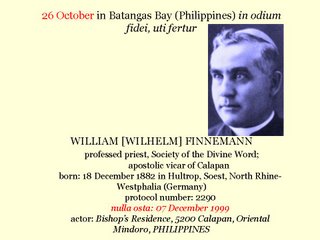
The story of the death of Bishop Wilhelm Finnemann, SVD would exemplify this ideal. He was the first SVD auxiliary bishop of Manila and probably the first German to become a naturalized Filipino citizen. The latest one is Fr. Ulrich Schlecht, SVD who was featured recently in the Philippine Star.

In 1936, Bishop Finnemann was appointed the first bishop of Mindoro. It was World War II. The war took its toll in Mindoro especially on women and children. Some Catholic schools and convents were being transformed into brothels for children. Women especially young girls were being abused raped and turned into “comfort women".

Bishop Finnemann strongly stood against these abuses and a number of times interceded and denounced the soldiers to free young girls who were forced to become sex slaves. The bishop was thus imprisoned and on October 26, 1942, he was thrown alive into the sea between Calapan and Batangas. One account describes that he died, "Along the way in the waters between Verde Island and Batangas, the soldiers bound his hands and feet, tied his body on a huge rock and dropped him overboard into the depths of the sea" (cited in fabc.org).

Years ago, bishops were used to be called "princes of the church", and the places where they lived were used be called “bishops’ palaces”. Today that term is softened to "bishops' houses" or "bishops’ convents".

I would think that royal title that the bishops had as "prince", was less a title of honor than a title of service. Bishops are our shepherds, in that sense, they are "princes", "kings" in the best sense of the term, one who is ready to lay down his life for others to live. This was embodied by the SVD bishop, William Finnemann.

The king must be ready to give his life like a shepherd to his sheep.

That is why when Pilate asked Jesus: "Are you the King of the Jews?" Jesus’ response was ambivalent-- it could be "yes" or it could also be "no".

Yes, he is a king in the sense of being shepherd, one who would lay down his life.

No, he is not a king in the sense that Herod the Great was "king of the Jews".

So Jesus’ reply is: "My kingdom is not of this world" (John 18:36, NIV).

This answer of Jesus has often been misunderstood as: Jesus' kingdom is not in this world, something out of this world, that it has nothing to do with the world. In Tagalog Biblia it says: "Ang Kaharian ko’y hindi sa sanlibutang ito" [which if translated means, "My kingdom is not in this world".

But this is not what it means when Jesus says that his kingdom is not OF this world. The Greek preposition "ek" can mean "of" but also "from". The expression may mean that Jesus' kingdom "is not from this world" (NRSV). The origin of Jesus' kingdom is not of this world, it did not come from this world. Its origin is from the Father of Jesus (Luke 22:29) (see also F. Moloney, The Gospel of John, p. 498).

Although Jesus' kingdom is not of this world, it is very much IN this world.

So Jesus said to Pilate, "For this I have come to world, to testify to the truth" (John 18:37).

Earlier, in John 12:47, Jesus explains this truth when he says "I have come not to judge the world, but to save the world'. The truth is the revelation of God and his plan to save the world (see I. de la Potterie, La Vérité dans Saint Jean).

The best Filipino image that Jesus’ kingdom is in the world is the image of Sto. Nino who, still a child, holds with ease the world in this hand, as if the burden of world is very light. Its contrast: the Greek god Atlas, portrayed as a muscular man, carrying the world, but as if the world is a burden to him.

Once Jesus said, in Matthew 11:28-30, "Come to me all you who are weary and carrying heaven burdens, I will give you rest. Take my yoke…for my yoke is easy and my burden is light."

Jesus cannot be taken away from the world, nor the world taken away from Jesus.

The Feast of Christ King then is an invitation, perhaps even a challenge to look at the world where Jesus is King. What kind of world is this?

The question before was: "Are you the King of the Jews?"

Today, the question can be: "Are you the King of the world?"

This feast is a celebration where are we are asked not to look our own personal needs, not at our own private concerns, not our families' or seminary's concerns, but at the concerns of the world. Not at what I need now, not at what my family needs now, not at my seminary needs now—but at "what the world needs now," as an old song goes.

This is an invitation as well as a challenge of Jesus as he had invited and challenged Pilate to join Jesus' company when he said: "Everyone who belongs to the truth, listens to my voice" (John 18:37). Listening to the voice is the proper response of the sheep to the Good Shepherd (John 10:3-4,8).

But Pilate said: "What is the Truth" (John 18:38)? This is not some kind of searching and cogitation in philosophy as what Socrates or Aristotle did in their quest for the Truth.

Pilate’s question is simply apathetic rejection of Jesus' invitation (F. Moloney, The Gospel of John, p. 498).

This invitation and challenge is also placed before us today: Everyone who belongs to the truth is ready to listen to Jesus’ voice.

Last Friday, the Diocese of Imus in Cavite where Divine Word Seminary in Tagaytay belongs had celebrated the Feast of Christ the King with an overnight vigil led by our Bishop, Chito Tagle.

In this vigil, more than 5,000 participants came over to the Girls' Town Complex in Silang to identify together the concerns of the world of Cavite and to bring these concerns to the feet of Jesus our king.

The concerns were overwhelming. It's a matter of just looking beyond those walls and malls.

That’s why it is still meaningful to consecrate the world to Christ the King as what we are about to do today. For it is not we, not our own effort, not even our good intentions will heal and save this world. It is Christ the King.

I would like to end this with one of the ancient prayers for a king found in the bible in Psalms 72. It was probably a prayer at the enthronement of a king inspired by Solomon’s accession to the throne. It is a prayer that would still be applicable today in our world. In the Early Church, the king in this Psalm was often identified to be Jesus:

1 Give the king your justice, O God, and your righteousness to a king's son.

2 May he judge your people with righteousness, and your poor with justice.

3 May the mountains yield prosperity for the people, and the hills, in righteousness.

4 May he defend the cause of the poor of the people, give deliverance to the needy, and crush the oppressor.

5 May he live while the sun endures, and as long as the moon, throughout all generations. 6 May he be like rain that falls on the mown grass, like showers that water the earth.
7 In his days may righteousness flourish and peace abound, until the moon is no more.

8 May he have dominion from sea to sea, and from the River to the ends of the earth.

9 May his foes bow down before him, and his enemies lick the dust.

10 May the kings of Tarshish and of the isles render him tribute, may the kings of Sheba and Seba bring gifts.

11 May all kings fall down before him, all nations give him service.

12 For he delivers the needy when they call, the poor and those who have no helper.

13 He has pity on the weak and the needy, and saves the lives of the needy.

14 From oppression and violence he redeems their life; and precious is their blood in his sight.

15 Long may he live! May gold of Sheba be given to him. May prayer be made for him continually, and blessings invoked for him all day long.

16 May there be abundance of grain in the land; may it wave on the tops of the mountains; may its fruit be like Lebanon; and may people blossom in the cities like the grass of the field.

17 May his name endure forever, his fame continue as long as the sun. May all nations be blessed in him; may they pronounce him happy.

18 Blessed be the LORD, the God of Israel, who alone does wondrous things.

19 Blessed be his glorious name forever; may his glory fill the whole earth.

Amen and Amen.

20 The prayers of David son of Jesse are ended.

[Translation from NRSV]